OES Spectrometry
Chemical Analysis —
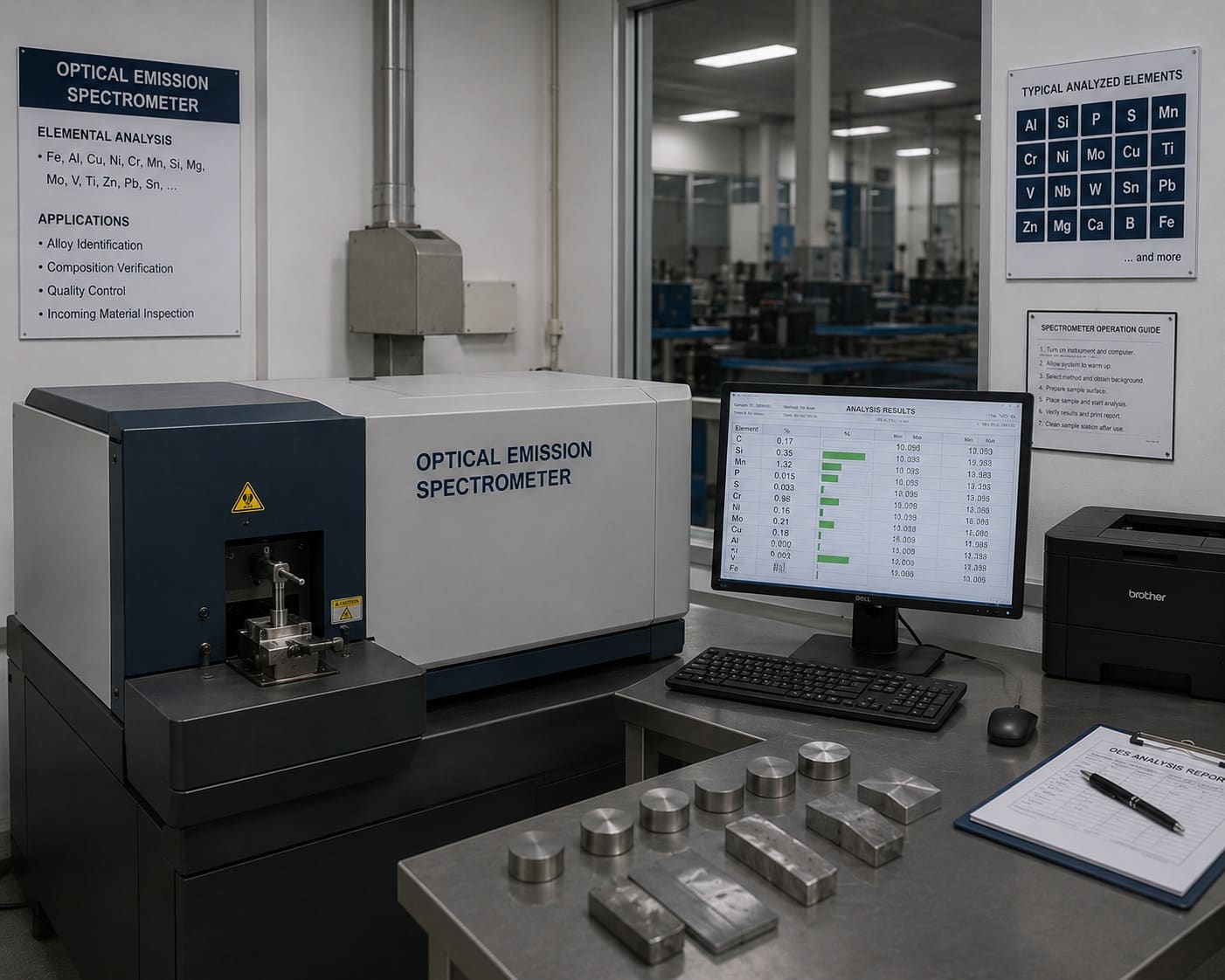
Optical Emission Spectrometry
Quantitative elemental analysis of metallic alloys — 27+ elements measured simultaneously in seconds. Grade verification, positive material identification (PMI), incoming inspection, and certification support. Results traceable to IS, ASTM, EN, DIN, and JIS material standards.
Request OES AnalysisWhat is Optical Emission Spectrometry?
OES excites metal atoms using a high-energy electrical spark discharged directly onto the sample surface. Excited atoms emit characteristic wavelengths of light — each element produces a unique spectral fingerprint. A multi-channel spectrometer records all emission lines simultaneously, delivering a complete elemental profile in under 30 seconds.
A single spark confirms whether a steel is IS 2062 E250 or E350, distinguishes SS 304 from SS 316 by molybdenum content, or reveals out-of-specification phosphorus and sulphur that would compromise weldability. Critical alloying elements such as chromium, nickel, vanadium, niobium, and boron are all resolved simultaneously within a single test cycle.
Base Materials Covered
Elements Analysed
Our OES spectrometer analyses 27+ elements simultaneously in a single spark cycle. The elements quantified depend on the base matrix (iron, copper, aluminium, zinc, or nickel base) and the applicable material standard:
ISO/IEC 17025:2017 — Accreditation Scope (Chemical)
NABL-Accredited Chemical Testing Scope
Carbon Steel / Low Alloy Steel
IS 8811:1998 (Ra 2018) · ASTM E415:2021
Al, C, Cr, Cu, Mn, Mo, Ni, P, Si, S, V
Stainless Steel (Austenitic)
IS 9879:1998 (Ra 2021) · ASTM E1086:2022
B, C, Cr, Cu, Mn, Mo, Ni, P, Si, S
Stainless Steel (Ferritic/Martensitic)
ASTM E1086:2022
C, Cr, Cu, Mn, Mo, Ni, P, Si, S
Iron & Steel / Alloy Steel
JIS 1253:2002
C, Cr, Cu, Mn, Mo, Ni, P, Si, S, V, Co, W
Typical Applications
Incoming Material Inspection
Verify supplier mill test certificate (MTC) values against the actual sample before material is accepted into production.
Grade Verification
Confirm grade — IS 2062 E250/E350/E410, EN8, EN24, SS 304/316/321, IS 1570 alloy steels, or any customer specification.
Positive Material Identification (PMI)
Identify unknown material or confirm grade of in-service piping, valves, and structural components before modification or welding.
Failure Investigation
Determine whether incorrect material composition or off-specification alloying was a contributory cause of in-service failure.
Pre-Heat Treatment Verification
Confirm that alloying elements are within the required specification window prior to heat treatment (carburising, nitriding, hardening).
Certification Support
Generate a chemical test certificate to supplement or replace a missing mill test report (MTR) for material traceability.